Truants

Updated: 20 hours ago
Creative Director / Lead Game Designer · True Ant Games
Truants is a 2D narrative mystery game played entirely through a simulated computer operating system. The player takes the role of Scott Bowers, a university professor whose ordinary day is disrupted when an anonymous user begins interfering with one of his online documents.
Through simulated software, websites, documents, messages, and other digital interactions, the player investigates a suspicious mental health center and uncovers the stories of a group of teenage victims known as the Truants. The ultimate goal is to help them escape using information discovered through Scott's computer.
Player decisions and the information they uncover directly affect the story. Acting without sufficient investigation—or overlooking critical evidence—can place both the Truants and Scott in danger and lead to different outcomes.

PROJECT OVERVIEW
Role: Creative Director · Lead Game Designer
Team: True Ant Games
Platforms: PC
Genre: 2D · Narrative Mystery · Investigation · Single Player
Core Focus: Narrative Systems · UI/UX · Puzzle Design · Interactive Storytelling
Tools: Unity · C# · Adobe Photoshop · Adobe Illustrator
Awards:
Silver Winner — 2024 NYX Game Awards (Game Design - Storyline)
Silver Winner — 2024 London Design Awards (User Interface Design - Games & Gaming-Related)
Bronze Winner — 2024 Indigo Design Award (Freelancer - Game Design for Social Change)
Background Story
Truants was inspired by a real controversy in China surrounding the treatment of young people labeled as suffering from “Internet addiction.”
The original concept drew specifically from the case of Yang Yongxin and the Linyi Internet Addiction Treatment Center, where controversial treatment methods, including electroconvulsive therapy, were used on adolescents and young adults. The people affected were not limited to teenagers who played video games; they also included esports players, online shop owners, and others whose use of the Internet was considered problematic by their families.
I first wrote about my desire to create a game inspired by this subject in my personal statement when applying to the Games and Playable Media M.S. program at UC Santa Cruz. In May 2019, I pitched the concept and formed a four-person development team.
The project was intended not only to bring greater attention to these events, but also to explore a broader idea at the center of the game:
People should not be subjected to severe punishment simply for harmless things they enjoy.
Early Concept
May 31, 2019 — Greenlight Pitch
At the end of the third quarter of the UCSC Games and Playable Media program, each student pitched an original game concept. Five projects passed the greenlight process and formed development teams, with the original creators taking the role of Creative Director.
Truants was one of those five projects.
At this point, the project consisted primarily of early Unity prototypes and design concepts rather than a playable build.
Game Interface

Core Loop

Find Messages
The player and a NPC have a conversation by editing the same Google Docs document

Highlighting all the texts in a Google Docs document to see the hidden cipher that typed in white color

Combining the first letter of each YouTube video's title in History to get the hidden message

Decipher Messages
Players use techniques such as Caesar ciphers to decode intercepted information.

Send Messages
Sending the escaping route you made for Truants members by setting the image as the cover of your online class video
Pre-Production & Vertical Slice
December 11, 2019 — Vertical Slice
During pre-production, our primary goal was to prove that the game's unusual computer-interface-driven structure was technically achievable.
In less than three months, we prototyped the core simulated applications and connected them to a playable section of Act 1.
The vertical slice was then presented to the same review panel that had evaluated the original greenlight pitch, serving as a milestone for whether the project was ready to continue into full production.
Vertical Slice Start Screen
Since Vertical Slice demo starts from the middle of Act 1 story, we provided the introduction and a computer button that you can press to start the demo.

Scott's Computer Login Screen

Scott's Computer Desktop

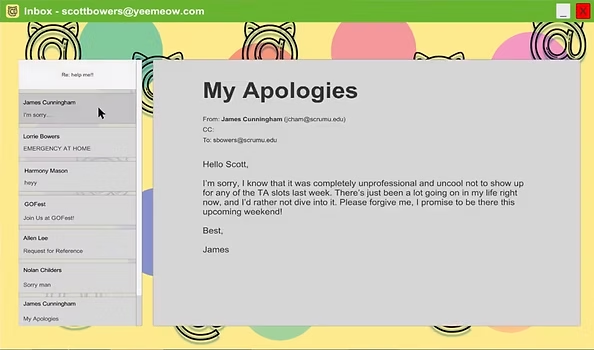
YeeMeow
Simulated E-mail application
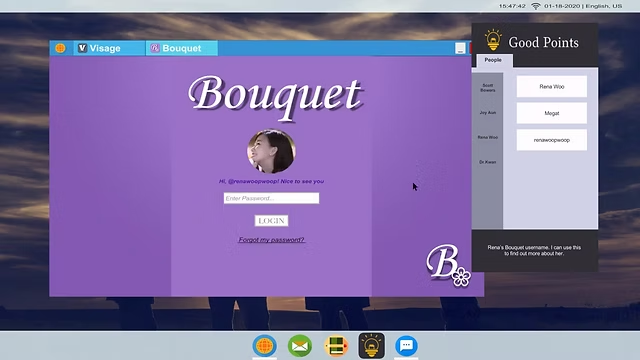
Visage
Simulated Facebook social media website in the simulated web browser which called "Brovo"


Bouquet
Simulated Instagram social media website


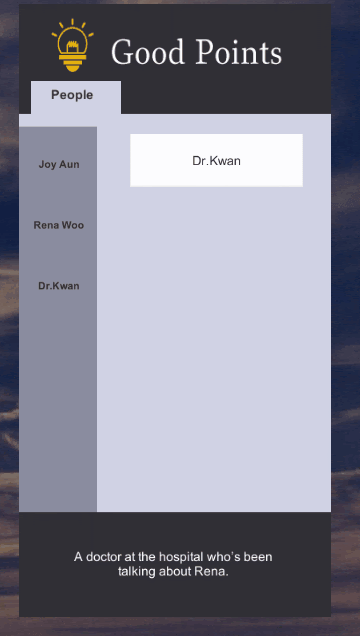
GoodPoints
A drag-and-drop note-taking app with keyword system

Haiyoo (Already renamed as Visager)
Simulated messaging app


Tudu
A sticky note reminder app that helps give players a push in the right direction with the story.

xPloit
A hacking cipher tool that provides hashed password, performs brute force attack on target computer, and shares the latter's screen on Scott's computer like a simulated TeamViewer.

LTBMC's Computer Desktop

File Browser

Ending Voice Over with subtitles

Production
During production, we replaced temporary narrative content with a polished version of Act 1, expanded the simulated operating system with additional applications, removed prototypes that no longer served the experience, and continued integrating gameplay, narrative content,
and original assets.

Main Menu
I created the main menu's interactive background and designed transparent interactive regions that visually respond when selected, integrating them with the conventional menu controls.

Brovo (Updated Version)
I built the upgraded version of Brovo using Unity UI and C#. The browser supports multiple page states, bookmarks, and URL-based navigation.

SyncDocs — Collaborative Document Prototype
I prototyped SyncDocs, a simulated collaborative document editor designed around the experience of communicating with another character through a shared online document.
The player and NPC use different text colors and typing behaviors. Player input triggers a simulated typing effect, while NPC responses use variable typing speeds to create the impression of another person actively editing the document.
Cursor behavior and timing were also used to communicate whether either participant was currently typing or had finished a message.

Challenges as Creative Director
1. Maintaining a Shared Design Vision
Truants was my first project leading an entire game design team. One of the earliest challenges was ensuring that developers from different cultural backgrounds shared the same understanding of the project's subject matter and design goals.
Because the story was rooted in events and social issues specific to China, I translated relevant Chinese-language material and gathered English-language references for the team. I also worked closely with the narrative designer to provide cultural context behind the story and its themes.
When written explanations were not enough, I increasingly relied on visual design documentation—flowcharts, diagrams, narrative maps, and interaction plans—to communicate systems and story structure across disciplines.


2. Balancing Passion and Scope
One of our biggest challenges was also one of the project's strengths: everyone wanted to build more.
Because Truants takes place inside a simulated computer, almost any type of software, website, interaction, or digital artifact could potentially become a game mechanic. That made scope control especially important.
I led dedicated scope-planning sessions and divided production into four stages:
Golden Path — Build only the systems and content required to play the main story from beginning to end.
Discovery — Add optional content and interactions that deepen the characters and world.
Polishing — Improve existing systems, UI, content, and moment-to-moment usability.
Finishing — Resolve remaining issues and prepare a stable, release-ready build.
3. Cross-Disciplinary Pipeline
Pre-Production Pipeline
Determine which features were technically achievable and which best supported the intended player experience.

Production Pipeline
Build, modify, and prioritize features according to the needs of the main narrative.

Comments